
When a Few Microns Decide Sensor Reliability
In automotive and industrial sensor manufacturing, maintaining stable production capability is often more challenging than achieving the first qualified sample.
A mold may successfully pass initial validation, yet dimensional variation can gradually appear after hundreds of thousands of molding cycles. Flash, terminal misalignment, inconsistent assembly force, and sealing failures are often discovered only after mass production begins.
Many engineers first look at injection parameters, material batches, or machine conditions. However, for highly precise sensor components, the real source of variation often begins much earlier — during the manufacturing of the mold components themselves.
The accuracy and long-term stability of mold inserts determine whether the injection mold can continuously reproduce the same geometry throughout its production life.
Case Study: Manufacturing a Precision Core Insert for a Micro Connector Component
A recent tooling project completed by E-TECH involved a precision core insert used for a multi-pin connector component.
The design challenge was concentrated within an extremely compact area.
The insert required seven precision structures within a total width of only 7.15 mm, with a 1.025 mm pitch between each feature. The individual slot width was only 0.59 mm, while the thinnest section of the insert tip was approximately 0.36 mm. In addition, the bottom transition required a precise R0.2 mm radius to ensure proper molding performance.
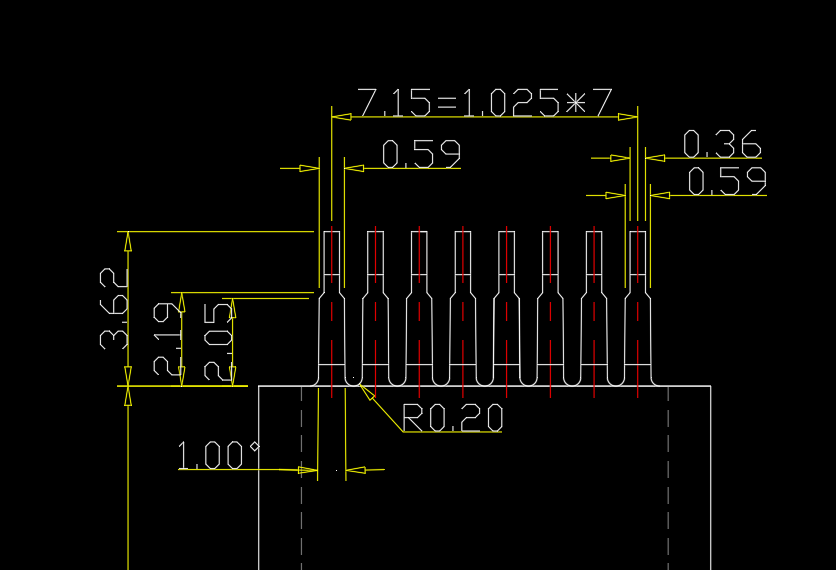
For a component of this scale, even a small dimensional deviation can directly influence the final molded part.
During injection molding, molten plastic flows around these micro features under high pressure. If the insert geometry, pitch accuracy, or mating surfaces are not precisely controlled, the resulting plastic component may experience:
- Flash around thin features
- Connector terminal misalignment
- Inconsistent assembly performance
- Reduced electrical reliability
Therefore, the challenge was not simply producing a dimensionally correct insert.
The real challenge was producing a mold component capable of maintaining accuracy throughout long-term production.
How Precision Manufacturing Ensures Long-Term Stability
To achieve this level of accuracy, the insert could not rely on a single machining process.
Instead, the component was manufactured through a controlled precision workflow.
Initial machining established stable reference surfaces and overall geometry. Wire EDM was then used to create the narrow slots and complex profiles where conventional cutting tools could not achieve the required detail.
For areas requiring sharp internal features and complex geometries, Makino EDM provided stable electrical discharge machining capability with excellent dimensional control.
After EDM processing, the insert went through precision grinding using our surface grinding capability, including Taiwan Dah Tong precision manual grinding equipment, to refine critical fitting surfaces and achieve the final dimensional requirements.
Before mold assembly, the completed component was verified through optical dimensional inspection to confirm critical features including:
- Slot width
- Pitch accuracy
- Profile geometry
- Radius dimensions
- Overall dimensional consistency
This multi-process approach ensures that each mold component is not only accurate after machining, but also reliable during long-term production.
Why In-House Toolroom Capability Matters
For precision sensor molding projects, the biggest risk is not always whether a supplier can manufacture one qualified mold insert.
The bigger question is:
Can the supplier maintain the same precision after months or years of production?
When machining, EDM, grinding, inspection, and mold fitting are controlled within different suppliers, every transfer introduces potential variation.
By maintaining an integrated toolroom, E-TECH can control critical processes internally, shorten engineering response time, and reduce accumulated dimensional variation.
This closed-loop approach provides a stronger foundation for maintaining long-term process capability.
Precision Is Not About One Measurement — It Is About Production Confidence
For sensor manufacturers, mold precision is ultimately measured by production performance.
The goal is not simply achieving a good first sample.
The goal is ensuring that the 100,000th or millionth molded component maintains the same dimensional consistency as the first approved part.
That is why precision mold manufacturing is not only about machining accuracy.
It is about creating a stable manufacturing foundation that allows sensor components to achieve reliable performance throughout their entire product lifecycle.