
Why Injection Gate Design Is Critical for Precision Sensor Plastic Parts
Many people consider the Injection Gate as simply the entrance where molten plastic enters the mold, believing it has little impact on product performance.
However, for precision plastic components used in automotive sensors and industrial sensors, the gate location directly affects cosmetic appearance, dimensional stability, and long-term reliability.
Especially for small-sized and high-precision components, an improper gate design can lead to flash, burrs, sink marks, warpage, and dimensional deviations.
For OEM customers, the factor that determines whether a product can achieve stable mass production is often not whether the mold can be manufactured, but whether the injection gate design is properly optimized.
How Does Injection Gate Location Affect Product Quality?
1. Gate Burr
If the gate design is not optimized or the process control is insufficient, burrs may remain after gate cutting.
For ordinary plastic parts, this may only be an appearance issue.
However, for precision sensor components, burrs may affect assembly performance and even influence sensor functionality.
2. Dimensional Tolerance
Many engineers overlook that the gate location can influence product shrinkage.
This is especially important when using glass-fiber reinforced materials such as GF30 and PA66 GF.
Different material flow directions may result in:
- Different shrinkage rates
- Different warpage behavior
- Dimensional variation
Ultimately affecting product tolerance.
3. Cosmetic Quality
If the gate is located on a visible surface area, it may leave:
- Gate vestige
- Weld lines
These defects may affect customer acceptance.
4. Mass Production Stability
A successful trial molding does not always mean successful mass production.
The real challenge is whether the gate quality can remain consistent after producing hundreds of thousands of parts.
Why Are Precision Sensor Plastic Parts More Difficult Than Ordinary Plastic Parts?
Sensor plastic components usually have the following characteristics:
- Small product size
- Tight tolerance requirements
- Complex assembly interfaces
- Strict appearance requirements
- Frequent use of glass-fiber reinforced materials
- 100% inspection requirements
Therefore, traditional injection molding experience alone cannot fully meet sensor industry requirements.
Engineering Analysis: Why the Injection Gate Became the Critical Challenge
The gate was located on a functional surface with tight dimensional requirements.
Because the component was molded with 30% glass fiber reinforced PBT, the material exhibited higher viscosity and different shrinkage behavior compared with unfilled resins.
Removing gate vestige after molding could easily change the local dimensions, while insufficient trimming would leave burrs that failed the customer’s cosmetic inspection.
This meant that cosmetic quality and dimensional accuracy became two conflicting requirements that had to be solved simultaneously.
E-TECH Real Engineering Case — Solving Injection Gate Burr Issues Under 20× Magnification
Project Background
In a European industrial sensor Miniature Sensor Housing project, the customer required that no visible burrs could be present in the Injection Gate area under 20× magnification.
At the same time, the product needed to meet strict dimensional tolerance requirements.
Because the gate was located close to a functional area, removing burrs could affect dimensional accuracy, while maintaining dimensions could leave residual burrs.
This became the biggest technical challenge during project development.
The material used was GF30% Valox 420SE0, and the component was relatively small.
In addition, the Injection Gate location could not affect subsequent assembly processes.
Challenges
According to the customer, previous suppliers had made multiple attempts but were unable to achieve both requirements simultaneously:
- Zero burrs
- High dimensional accuracy
Removing burrs easily caused dimensional changes, while maintaining dimensions increased the risk of remaining burrs.
The two requirements were difficult to balance.
Typical Reasons Include
- Gate location not optimized
- Inadequate venting
- Improper gate trimming process
- Process window too narrow
- Mold wear during mass production
E-TECH Engineering Analysis
After receiving the customer’s drawings, E-TECH first organized a DFM review and conducted a detailed engineering analysis based on the product structure.
The key evaluation points included:
- Injection Gate location
- Plastic flow direction
- Product wall thickness distribution
- Mold venting
- Gate cutting method
- The impact of post-processing on dimensions
After multiple mold trials and validations, the engineering team continuously optimized the process window.
Rather than relying on secondary trimming, our engineering team focused on optimizing the molding process itself to eliminate burr formation at the source.
Final Results
E-TECH achieved:
- No burrs in the Injection Gate area under 20× magnification
- Product dimensions meeting drawing tolerance requirements
- Stable mass production capability
Engineering Trade-offs
When developing precision sensor components, improving one characteristic often affects another.
For this project, removing gate burrs aggressively could influence dimensional accuracy.
Maintaining dimensional accuracy, however, increased the risk of visible gate vestige.
Our objective was therefore not simply to eliminate burrs, but to achieve an optimized balance between cosmetic quality, dimensional stability, and production consistency.
Beyond Equipment: Engineering Capability Matters More
Many customers believe that owning advanced injection molding machines is enough to produce high-precision components.
However, for precision sensor parts, the factors that truly determine product quality are not only equipment, but the entire engineering development capability.
Key capabilities include:
- DFM review capability
- Mold design experience
- Injection molding process optimization
- Dimensional analysis
- Quality inspection capability
Equipment and Process Optimization
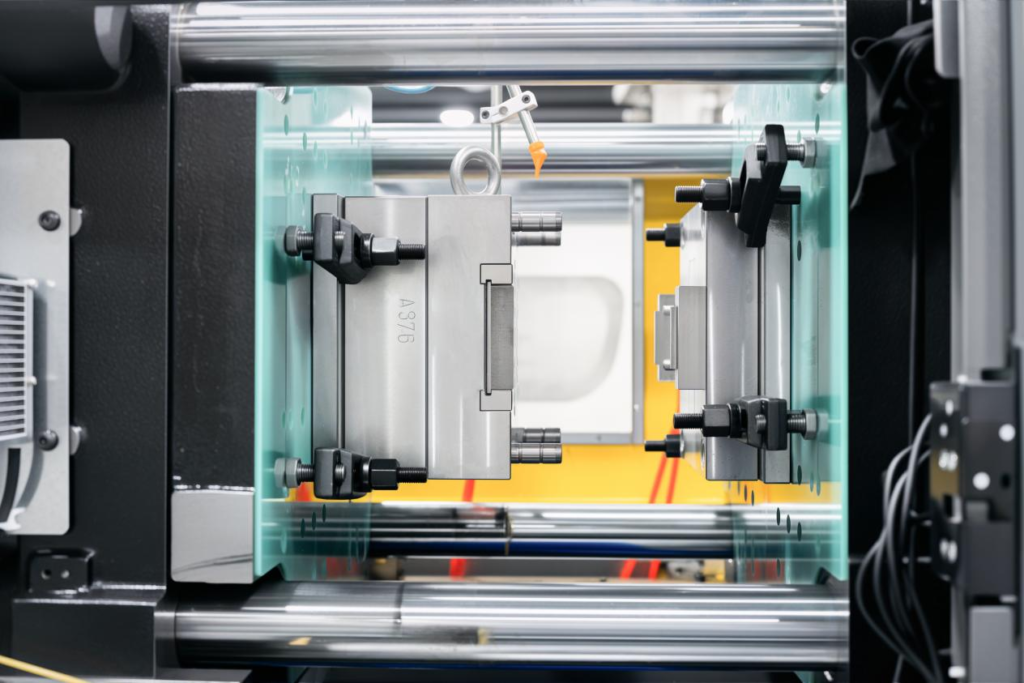
Instead of relying solely on high-end equipment, we combined process optimization with FANUC electric injection molding machines to achieve consistent dimensional control during mass production.
How Can OEM Customers Reduce Injection Gate Risks?
During the early product development stage, suppliers should be involved in DFM reviews as early as possible.
Important considerations include:
- Is the gate location reasonable?
- Does it affect appearance?
- Does it affect dimensions?
- Is it suitable for mass production?
- Does it meet assembly requirements?
The earlier problems are identified, the lower the modification cost will be.
How E-TECH Helps OEM Customers Achieve Precision Injection Molding
E-TECH specializes in manufacturing precision structural components for automotive and industrial sensors.
During product development, our engineering team provides:
- DFM review
- Mold optimization suggestions
- Precision injection molding
- Dimensional inspection
- Small-batch trial production
- Stable mass production support
These capabilities help OEM customers shorten development cycles and reduce production risks.
Lessons Learned
This project reinforced an important engineering principle:
For precision sensor components, injection gate design should never be considered only from a molding perspective.
It directly affects:
- Cosmetic appearance
- Dimensional accuracy
- Assembly quality
- Long-term production stability
Early DFM involvement can significantly reduce tooling modifications and development time.